
Understanding Dental Implants
At Blue Ridge Family Dentistry, we understand that missing teeth are about more than just aesthetics. It’s a complex issue that affects how you eat, how you speak, and, perhaps most significantly, how you feel about yourself when you look in the mirror. We hear stories every day from patients who hide their smiles behind their hands or avoid their favorite foods because chewing has become difficult or painful.
If you are navigating life with missing teeth—whether it’s a single gap that bothers you or you are currently struggling with uncomfortable traditional dentures—it is time to explore the modern gold standard in tooth replacement: dental implants.
This isn't just about filling a space in your mouth. It is about restoring the structural integrity of your jaw and giving you back the confidence to laugh freely and eat whatever you want. We have created this comprehensive guide to walk you through everything you need to know about dental implants, the life-changing advantages they offer, and the vital differences between fixed and removable solutions.
Beyond the Bridge or Denture: What Is a Dental Implant?
To understand why dental implants are so revolutionary, we first need to look at what happens when you lose a tooth.
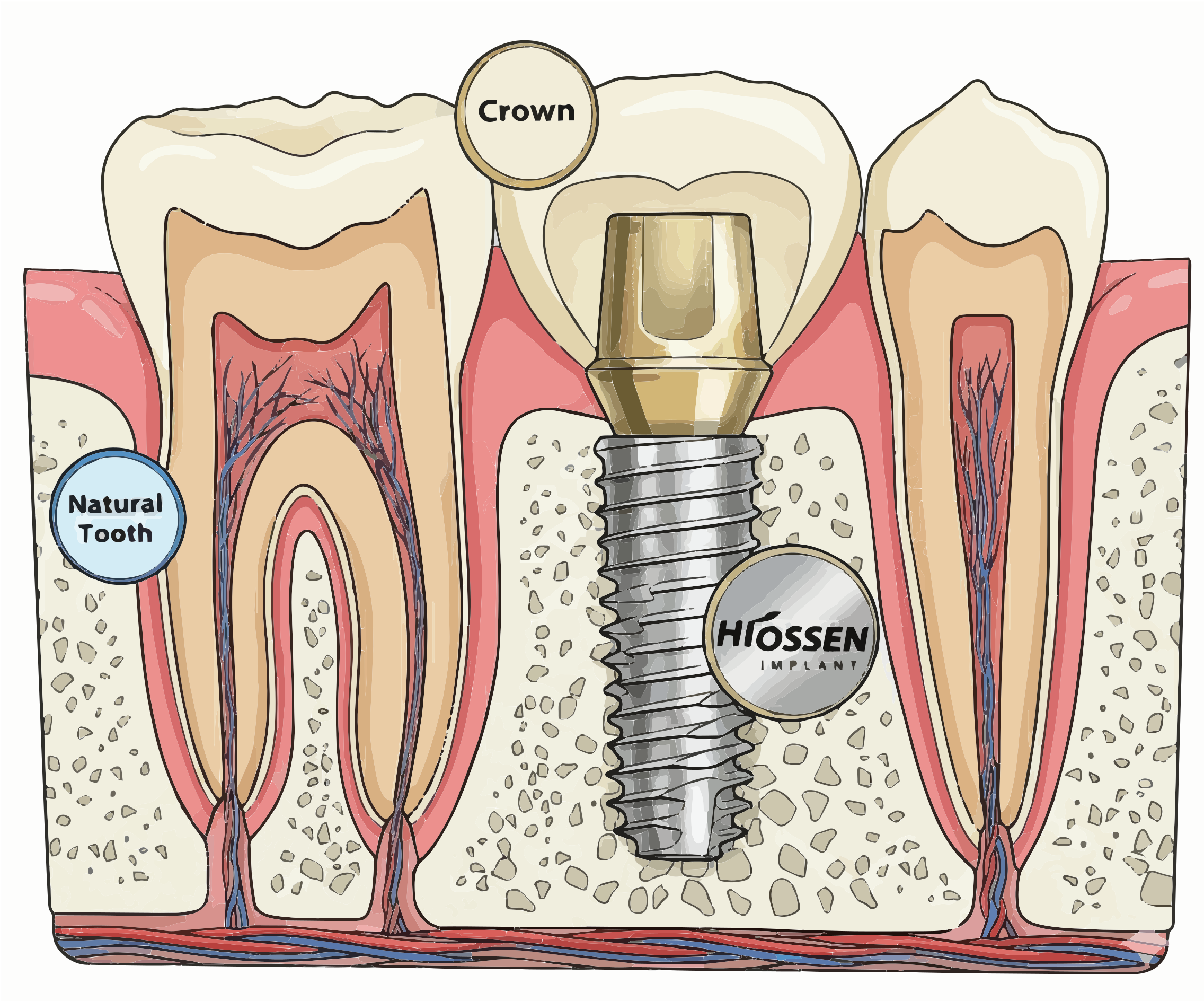
A natural tooth is more than just the white crown you see above the gumline. Underneath the surface, there is a root anchored firmly into your jawbone. This root does two critical jobs: it holds the tooth stable against the massive forces of chewing, and it stimulates the jawbone, signaling to your body that the bone in that area is needed.
When you lose a tooth, you lose that root. Traditional options like dental bridges or standard dentures only replace the visible crown. They sit on top of the gums or rely on neighboring teeth for support. They do nothing to replace the root structure beneath.
A dental implant is different. It is the only dental restoration option that replaces the entire tooth structure, from root to crown.
The Three Components of an Implant Smile
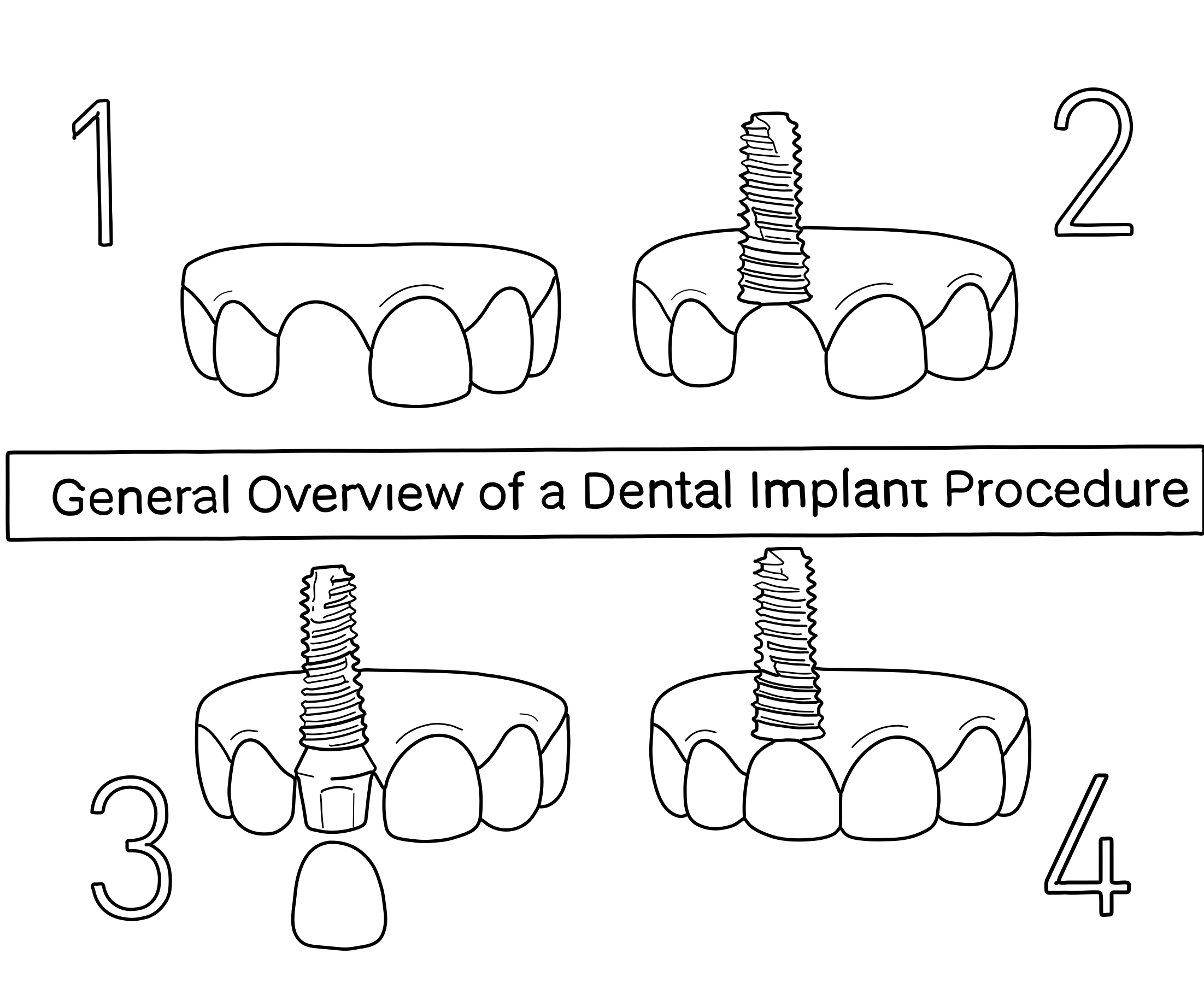
When we talk about getting "an implant," we are actually talking about a system usually comprised of three separate parts working together:
- The Implant Fixture (The Post): (Labeled Step 2 in the diagram) This is the implant itself—a small, screw-like post usually made of medical-grade titanium. Titanium is used because it is biocompatible, meaning the body rarely rejects it. This post is surgically placed into the jawbone and serves as the new artificial root.
- The Abutment (The Connector): (Labeled Step 3 in the diagram) Once the implant post has healed and integrated with the bone, a connector piece called an abutment is attached to the top of it, usually sitting right at the gumline. This piece serves as the anchor for the final tooth.
- The Restoration (The Visible Tooth): (Labeled Step 4 in the diagram) This is the part everyone sees. Depending on your needs, this could be a single porcelain crown (for one missing tooth), a bridge, or an entire arch of prosthetic teeth.
You can read more about the basics of dental implants from the American Dental Association (ADA) here.
The Advantages: Why Implants Are the Gold Standard
Deciding on a tooth replacement option is a significant medical and financial decision. While traditional bridges and dentures have served patients for decades, dental implants offer distinct physiological advantages that other methods simply cannot match.
Here is why dentists overwhelmingly recommend implants as the long-term solution for missing teeth.
1. Preventing Bone Loss (The "Use It or Lose It" Principle)
This is perhaps the most critical, yet least understood, benefit of dental implants.
Your jawbone is living tissue. Like muscle, it requires stimulation to stay strong and dense. Natural tooth roots provide this stimulation every time you chew. When a tooth is lost, that stimulation ceases.
Without that signal, the body begins to resorb (dissolve) the bone in that area, believing it is no longer necessary. This is why people who have worn traditional dentures for many years often develop a "sunken" facial appearance; their jawbone has literally shrunk beneath them. This shrinkage is also why dentures become loose and uncomfortable over time, requiring frequent relining.
Because a dental implant is embedded in the bone, it acts like a natural root, transmitting chewing forces and stimulating the bone to maintain its density and volume. Implants are currently the only restoration method that can delay or prevent bone loss.
2. Unmatched Stability and Chewing Power
If you currently wear traditional dentures, you know the anxiety of wondering if they will slip when you speak or laugh. You also know the frustration of the "do not eat" list: steak, corn on the cob, crunchy apples, or sticky candies.
Traditional dentures typically provide only about 20% to 25% of maximum natural chewing capacity because they rest on soft gums that can tolerate only so much pressure.
Dental implants are anchored in bone. Whether you have a single implant crown or a full arch of implant-supported teeth, they provide bite force comparable to natural teeth. You can return to eating a complete, healthy diet—including crunchy vegetables and varied proteins—without fear of embarrassment or discomfort.
3. Protecting Healthy Neighboring Teeth
Before implants became common, the standard way to replace a single missing tooth was a dental bridge. A bridge works by placing crowns on the two healthy teeth on either side of the gap, which suspend a false tooth between them.
To place those crowns, the dentist must significantly file down the healthy enamel of those adjacent teeth to shape them as pegs. You may be essentially damaging two good teeth to replace one bad one.
A single dental implant is a standalone unit. It does not rely on other teeth for support. Your surrounding healthy teeth are left completely untouched, preserving your natural tooth structure for longer.
4. Permanence and Long-Term Value
While the upfront investment for dental implants is higher than bridges or dentures, their longevity often makes them the most cost-effective solution over a lifetime.
A traditional dental bridge may need replacing every 10 to 15 years due to wear or decay developing under the supporting crowns. Dentures need frequent adjustments and replacements as the jawbone changes shape.
A well-placed and properly maintained dental implant fixture can last for decades. While the visible crown on top might eventually need replacement due to normal wear and tear, the underlying foundation if maintained in a healthy environment it can remain solid.
For a deeper dive into the history and success rates of osseointegration, the process that makes implants work, you can visit this Wikipedia entry.
Defining Your New Smile: Fixed vs. Removable Implant Solutions
One of the most confusing aspects for patients is understanding the variety of implant options available. It’s not just about replacing one tooth; implants can be used to support entire sets of teeth.
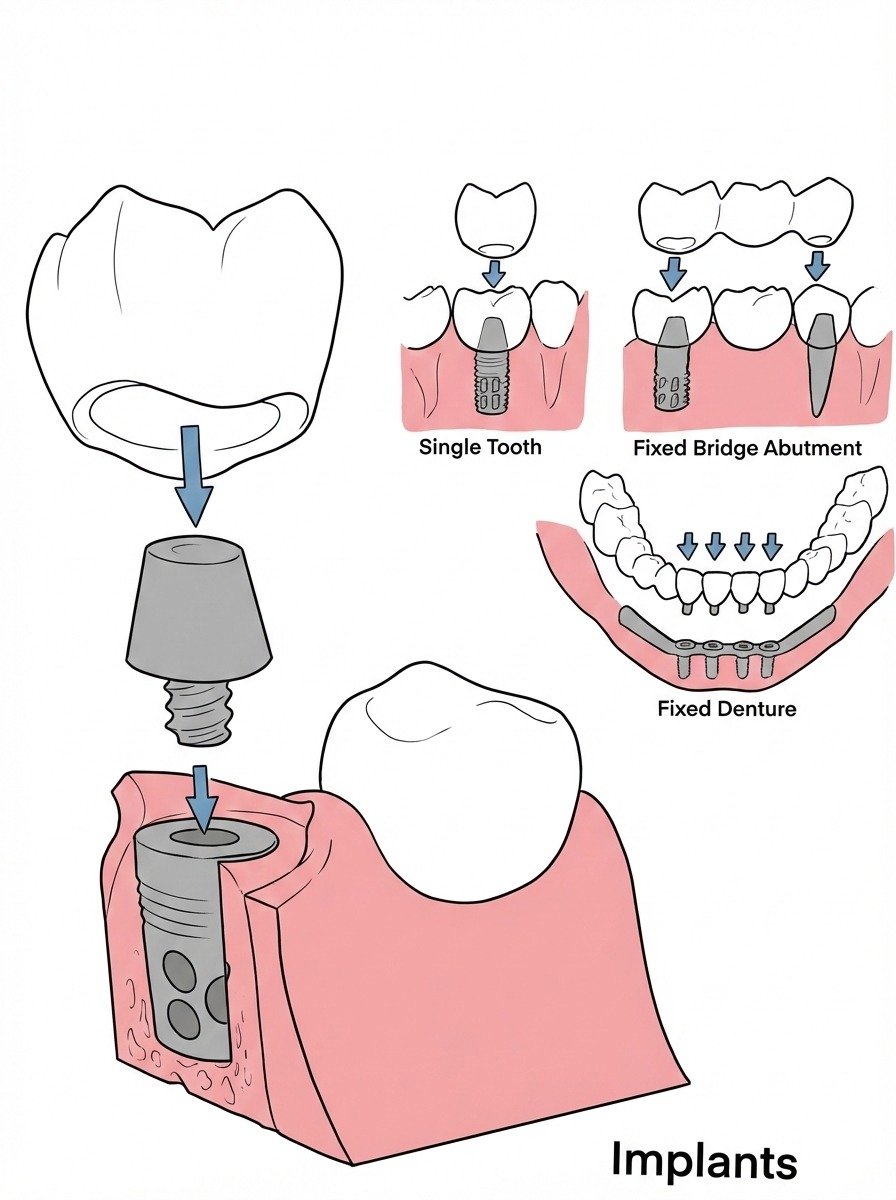
The biggest distinction you need to understand is between Fixed Restorations (teeth that stay in your mouth permanently) and Removable Implant Restorations (teeth you take out for cleaning, but that snap securely into place).
Neither is inherently "better"; the right choice depends on your bone structure, your lifestyle, your budget, and your personal preferences.
Option A: Fixed Implant Restorations (Permanently fixed in place)
These solutions are designed to be as close to natural teeth as possible. You brush them in your mouth, you do not take them out at night, and they feel exceedingly stable.
1. The Single Tooth Implant Crown
If you are missing just one tooth, this is the ideal solution. One implant post is placed in the gap, and one custom-made abutment and porcelain crown is attached to it. It looks, feels, and flosses just like a natural tooth.
2. Implant-Supported Bridges
If you are missing three or four teeth in a row, we don't necessarily need to place an implant for every single missing tooth. Instead, we can place two implants—one at each end of the gap—and span a fixed bridge between them. This is incredibly strong and more economical than individual implants for every lost tooth.
3. Full Arch Fixed Restoration (Often called "All-on-4" or "All-on-X")
This is a life-changing procedure for patients who are missing all their upper or lower teeth, or whose remaining teeth are failing and need extraction.
Instead of a removable denture, we place a specific number of implants (usually four to six) placed strategically into the jaw arch. A full horseshoe-shaped set of beautiful, prosthetic teeth is then permanently screwed onto these implants.
Why choose fixed full arch?
- The closest feeling to natural teeth: They do not cover the roof of your mouth, they don't move, and you care for them similarly to natural teeth (though using tools like a water flosser becomes very important to clean underneath them).
Option B: Removable Implant Restorations (Snap-On Dentures)
Often called "implant-supported overdentures," this option is a fantastic middle ground between conventional dentures and fully fixed implants.
With this system, we typically place two to four implants in the jaw. Instead of a permanent set of teeth screwed onto them, the implants are fitted with special "snap" attachments (like a ball-and-socket joint or a bar clip). The denture is made with corresponding sockets underneath.
You still take the teeth out at night to clean them and to brush off the gum tissue around the implant posts, but when you put them in, they snap firmly into place.
Why choose implant-supported removables?
- No more glue: They rely on mechanical attachments, not messy dental adhesives.
- Massive stability improvement: While not quite as rock-solid as a fixed option, they eliminate the floating, rocking, and chafing common with regular dentures. They significantly improve chewing ability compared to standard dentures.
- Easier hygiene for some: Because you take the teeth out, it can be easier to thoroughly clean the denture and the gum tissues. This is sometimes an advantage for elderly patients or those with limited dexterity who might struggle to floss under a fixed bridge.
- Cost: This option is generally less expensive than a fully fixed (All-on-4 style) restoration because fewer implants are usually required and the prosthetic materials are different.
Summary Comparison: Fixed vs. Removable Implant Solutions
| Feature | Fixed Restorations (Crowns, Bridges, All-on-4) | Removable Restorations (Snap-On Overdentures) |
|---|---|---|
| How it stays in | Permanently screwed or cemented onto implants. | Snaps onto implants, removable by the patient. |
| Daily Care | Brushing and specialized flossing in the mouth. | Remove to clean denture and gums separately. |
| Chewing Force | Highest (closest to natural teeth). | Very High (significantly better than regular dentures). |
| Stability | Rock-solid, no movement. | Very stable, minor movement possible but no slipping. |
| Palate Coverage | Usually does not cover the roof of the mouth. | Upper denture may still cover some of the palate, but less than standard dentures. |
| Cost Variation | Typically higher investment. | Typically more moderate investment. |
| Maintenance | Will need longer hygiene appointment yearly to remove appliance and clean. | Will need to replace snaps inside denture as they wear out, typically 1 - 3 years |
The Patient Journey: What to Expect From the Procedure
Understandably, the idea of dental surgery makes many patients nervous. We find that anxiety comes from the unknown. By explaining exactly what happens, we hope to alleviate those fears.
While every case is unique, the implant journey generally follows this roadmap.
Phase 1: Comprehensive Consultation and High-Tech Planning
The first step is a conversation. We need to understand your goals, your medical history, and your concerns.
We don't just guess where an implant should go. We utilize advanced 3D imaging technology called Cone Beam CT (CBCT) scanning. Unlike standard 2D dental X-rays, a 3D scan gives us a virtual model of your jaw, showing us the exact bone width, height, and density, as well as the location of critical nerves and sinuses.
This allows us to "perform" the surgery virtually on the computer before we ever touch your mouth. We plan the exact angle and depth of the implant for maximum stability and safety.
Phase 2: Preparing the Foundation (Pre-treatments)
Sometimes, the 3D scan reveals that the jawbone isn't currently strong enough or wide enough to support an implant. This is common if a tooth has been missing for a long time.
If this is the case, we may need to perform a bone graft. This sounds intimidating, but it is a very common, routine procedure. We place bone grafting material (which looks like coarse powder) in the area where bone is deficient. Over a few months, your body absorbs this material and replaces it with its own dense, healthy living bone, creating a solid foundation for the implant.
If you need extractions of failing teeth, these are often done during this phase, sometimes simultaneously with the bone graft or implant placement.
Phase 3: The Placement Surgery
Many patients are surprised to find that the actual implant placement surgery is often easier than having a tooth extracted.
We ensure you are completely comfortable. This usually involves local anesthesia (numbing the area completely), and many patients opt for nitrous oxide during and pre-medication prior to the appointment to feel relaxed and often doze through the procedure.
Because of our extensive 3D pre-planning, the surgery is precise and efficient. The dentist makes a small incision in the gum tissue to access the bone, prepares a small channel, and gently guides the titanium implant post into place.
You may leave the office with a temporary tooth or denture so you are not walking around with a gap during healing.
Phase 4: The Healing Period (Osseointegration)
This is the most crucial phase, and it requires patience.
Although the implant is sitting snugly in the bone on day one, it is not yet ready to handle the force of chewing a steak. A remarkable biological process called osseointegration must occur.
Derived from Greek and Latin meaning "bone" and "to make whole," osseointegration is the process where your jawbone cells literally grow right up against the surface of the titanium implant, fusing with it. This process locks the implant securely into the jaw.
This healing usually takes anywhere from three to six months. During this time, you will likely be on a softer diet to avoid disturbing the implant while it integrates. There is usually very little pain during this phase; it's simply a waiting game while biology does its work.
Phase 5: The Final Restoration (The Reveal!)
Once we have confirmed the implant has successfully fused to the bone, the finish line is in sight.
We will uncover the top of the implant, attach the abutment, and take highly accurate impressions (molds) or digital scans of your mouth. These are sent to a specialized dental laboratory.
Skilled technicians will custom-craft your final crown, bridge, or denture, ensuring the color, shape, and size match your natural teeth and facial structure perfectly.
A few weeks later, you return to our office for the final fitting. We check the bite, ensure you love the aesthetics, and permanently secure your new smile in place.
Living with Implants: Long-Term Care and Expectations
One of the most common questions we get is, "Are dental implants permanent?"
With proper care, the implant post itself can last for many years. However, dental implants are not "set it and forget it." They require maintenance just like natural teeth. Proper maintenance leads to longevity.
The Importance of Hygiene
While titanium and porcelain cannot get cavities, the gum tissue and bone supporting the implant can still get infected by bacteria in plaque.
If plaque is allowed to build up around the gumline of an implant, it can cause inflammation called peri-implant mucositis (similar to gingivitis). If left untreated, this can advance to peri-implantitis, a destructive condition where the infection begins to eat away at the bone holding the implant in place. Peri-implantitis is the number one cause of late-stage implant failure.
How to protect your investment:
- Commit to brushing: Twice a day, thoroughly, just like natural teeth.
- Specialized Flossing: Flossing around an implant crown is slightly different than a natural tooth. If you have a fixed bridge or All-on-4, you will need to use "superfloss" (floss with a stiff end to thread under the bridge) or interdental brushes to clean underneath the prosthetic.
- The Water Flosser is Your Friend: Many implant patients find a water flosser to be an indispensable tool for flushing out debris and bacteria from hard-to-reach areas around implant posts.
Professional Maintenance
Regular check-ups at our practice are non-negotiable for implant patients. We need to see you at least every six months.
During these visits, we take special X-rays to monitor the bone level around the implant to ensure it remains stable. Our hygienists use specialized instruments designed to clean implant surfaces without scratching them. Catching minor inflammation early is key to preventing major bone loss later.
Frequently Asked Questions About Dental Implants
We know this is a lot of information to absorb. Here are answers to some of the most pressing questions we hear during consultations.
Am I too old for dental implants?
Almost certainly not. Generally speaking, there is no upper age limit for dental implants. We have successfully placed implants in patients in their 80s and even 90s. The determining factors are your overall health and the quality of your bone, not the year on your birth certificate. If you are healthy enough to undergo a routine tooth extraction, you are likely healthy enough for an implant.
Will it look natural?
Yes. Modern dental ceramics are incredible. We can match the shade, translucency, and texture of your surrounding natural teeth precisely. When done correctly, even close friends and family usually cannot tell which tooth is the implant.
Do I have enough bone?
Many patients have been told in the past that they don't have enough bone for implants. However, modern techniques have changed the game. With advanced bone grafting procedures, sinus lifts (adding bone to the upper jaw area near the sinuses), and specialized implant types, we can now help many patients who were previously told they weren't candidates. The only way to know for sure is through a 3D CT scan consultation.
Does the procedure hurt?
We take patient comfort very seriously. The procedure itself is done under robust local anesthesia, so you shouldn't feel pain during the surgery. Most patients report that the recovery is easier than they anticipated—often easier than recovering from a tooth extraction. Any post-operative discomfort can usually be managed effectively with over-the-counter pain relievers like ibuprofen or acetaminophen for a few days.
How much do dental implants cost?
This is the toughest question to answer without an examination because every mouth is totally different. The cost depends on the number of implants needed, the type of final restoration (fixed vs. removable), whether bone grafting is required, and your dental insurance coverage.
Implants are a significant investment. However, when you compare the lifetime cost of an implant against replacing bridges or dentures multiple times over decades—not to mention the value of bone preservation and quality of life—many patients find them to be the best long-term financial decision for their health. We always provide a detailed, transparent breakdown of costs before any treatment begins and can discuss financing options to make care manageable.
Taking the Next Step Toward Renewed Confidence
If you are tired of hiding your smile, struggling with loose dentures, or worrying about the long-term health of your jawbone, dental implants offer a proven, life-changing solution.
While the process involves time and investment, the payoff is a return to normalcy. It’s the ability to bite into a crisp apple, to laugh out loud without a second thought, and to look in the mirror and see a complete, healthy you.
Reading about implants is a great first step, but the only way to know what is right for your specific situation is a personalized evaluation. We invite you to contact our practice to schedule a consultation. Let’s sit down, look at the 3D imaging together, and map out a plan to restore not just your teeth, but your quality of life.